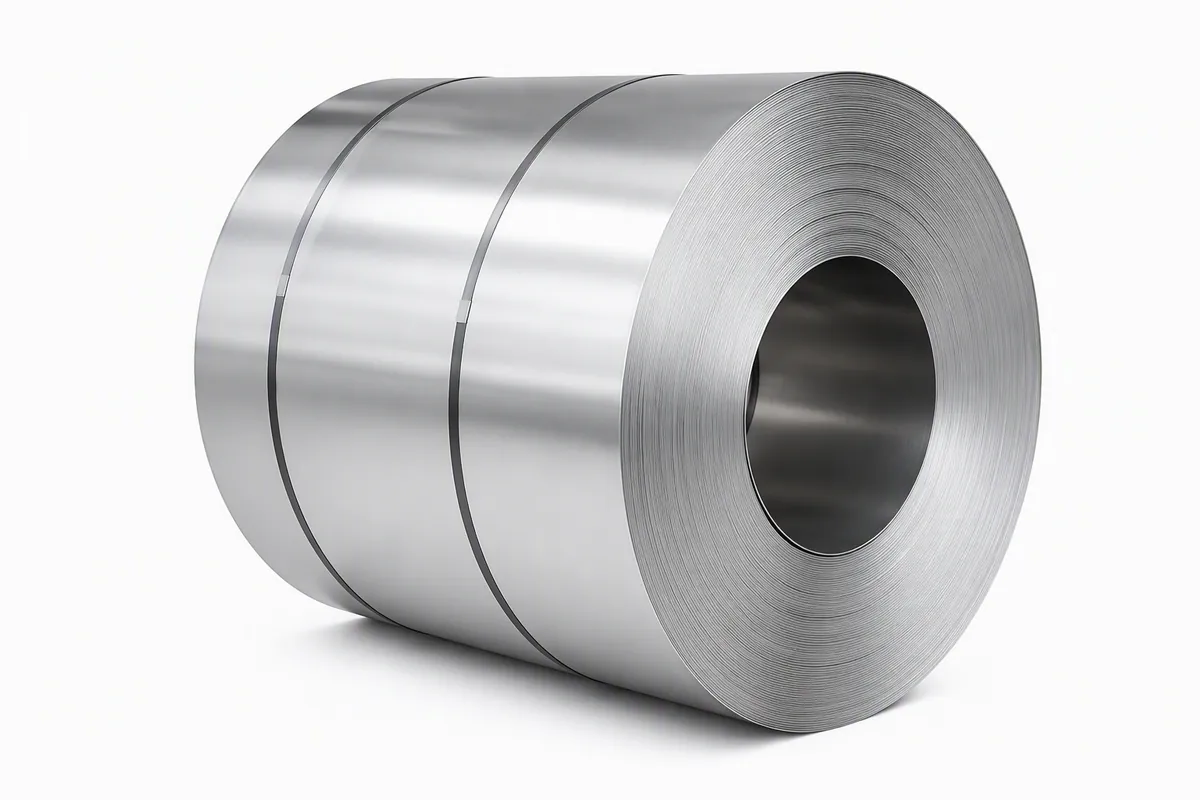
A coil ordered at 0.5 mm nominal is never exactly 0.5 mm, because no rolling mill delivers an exact figure. Every order sits inside a tolerance band defined by the standard it is placed against, whether that is an EN, ASTM, GB or JIS designation, and the band is fixed at the mill before the coil is rolled. Two offers quoting the same nominal thickness can sit at opposite ends of that band, and the gap is measurable in the material you actually receive.
The commercial effect depends on how the order is priced. Bought on theoretical weight, a coil rolled toward the low side of the band yields more square metres per ton, and one rolled toward the high side yields fewer. Bought on actual weight, the invoice follows the scale, but yield per ton still moves with the thickness you get. Either way the buyer who never asked which side of the band the mill targets is the one who finds out at the press brake rather than at the quotation stage.
Three questions settle this before the order is placed. Ask which standard the tolerance is measured against, ask whether the mill controls to nominal or to a target inside the band, and ask how the thickness is verified and recorded, since a mill test certificate reports chemical and mechanical results while dimensional checks are normally a separate inspection record. Then confirm on arrival with a micrometer at several points across the width, because thickness is not uniform from edge to centre.
This is a specification conversation rather than a price conversation, and it is the one worth having first. Xi’an Junlin Chicheng Metal Products Co., Ltd has supplied steel since 2003, first through our predecessor business and now under this company, sourcing from long-term partner mills that operate ISO 9001 quality systems, and every ton ships with a mill test certificate traced to its heat number. Send the grade, the nominal thickness, the tolerance standard and the destination port, and we will confirm what the mill can hold, the lead time and the shipping weight, usually within one working day.